

What Are Tactile Indicators (TGSI)? A Guide for Australia?
Tactile Ground Surface Indicators (TGSI) serve as a tool for navigation that is used to assist visually impaired persons. These indicators help the user perceive changes in the environment by means of sensation from the sole of the shoe or a cane. TGSI are installations found within the private as well as the public sector, especially in areas where there are changes in direction at street crossings, stairs and edges of platforms.
Understanding Tactile Ground Surface Indicators
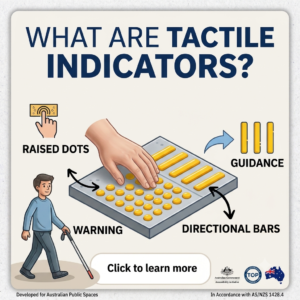
Tactile Ground Surface Indicators (TGSI) refer to flooring that is meant to offer information to visually impaired people for safe and independent mobility in many situations. There are generally two types of floor indicators, namely tactile warning studs and tactile directional strips. While studs are truncated domes meant to warn people about caution areas such as curbs, stairs and platform edges the latter are directional in nature. Can guide a person on a particular path or towards an exit area.
Many developments in technology and design have been made since then in order to facilitate types of TGSI such as integrated tactile tiles and PU & SS tactile tiles, among others.
Types of Tactile Ground Surface Indicators
The Tactile Ground Surface Indicators (TGSI) come in forms that perform unique functions to help guide visually impaired persons. It is useful to learn about these forms.
Tactile Warning Indicators
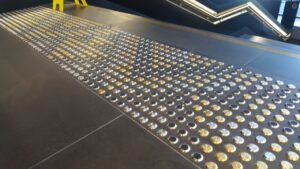
Tactile warning markers consist of raised markings on surfaces to indicate approaching dangers or changes in the path. The markers are mainly used along the edge of train platforms, pedestrian crossing points, and both ends of staircases. Some materials that are commonly used in making tactile warning markers include steel (SS tactile markers), polyurethane (PU tactile studs), and concrete. Tactile markers are commonly found in areas that are frequented by people.
Stainless Steel Tactile Directional Strip Tiles Linear Pattern Strips
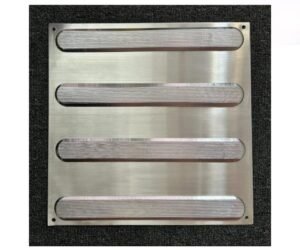
Stainless Steel Tactile Directional Strip Tiles Linear Pattern Strips
Unlike marker studs, tactile directional strips provide guidance along a route. Composed of a sequence of lines or other patterns such strips show the mode of travel used by those who are partially or totally blind so that they can move in a straight line in big open areas such as buildings, stations, etc. The structure of strips must comply with strict regulations to be effective in navigation as strips are made of various materials, the most popular being polyurethane (PU) strips, which allow for wear resistance and good comfort during walking. The placement of directional routes must also be well-planned.
Stainless Steel Tactile Tiles
Tactile tiles made of steel are often preferred for their durability and aesthetic touch. The advantage of tiles manufactured of stainless steel is that they are extremely durable and weather-resistant, which makes them ideal for use in areas with heavy pedestrian traffic. Stainless steel tactile tiles can typically be used in cities where durable materials are required. What is more, the appealing look of steel ideally fits modern architectural planning.
Choosing the Right Tactile Solutions
The selection of the TGSI for various situations is an important element of urban planning and accessibility. The knowledge of what factors determine the selection of the TGSI will be helpful in installing an long-lasting solution.
Factors to Consider When Selecting TGSI
- Environment: The environment where TGSI are to be installed is an important aspect when selecting the material and the type of indicator. In case of outdoor installation, materials that are capable of withstanding various weather conditions as well as foot traffic, such as SS or PU, are advisable. On the other hand, when dealing with an indoor environment, aesthetics and foot traffic determine the type of indicator selected.
- Traffic Volume: For high-traffic zones, it is necessary that the TGSI used be able to withstand considerable usage without having its tactile characteristics affected. SS tactile tiles and high-density PU are examples of such materials.
- Aesthetic Considerations: In cases where aesthetics and design matter, the selection of the TGSI should be consistent with the whole architectural theme. For instance, SS tiles provide a modern aesthetic appearance, while the tactile tiles can be made to blend in with the rest of the floor.
- Safety and Compliance: It is essential to ensure that the chosen TGSI comply with local accessibility requirements and safety standards. This includes the contrast in colour and texture between the TGSI and their surrounding areas to make them easily distinguishable.
Cost and installation: Cost and the ease of installation of the TGSI must also be taken into account. Although some materials are costlier at first, they can save money in the long run.
Impact of Material on Life and Effectiveness of TGSI
In addition to having an influence on the initial feel of TGSI, the material of TGSI has an impact on its life and effectiveness when functioning.
Materials such as stainless steel have an outstanding life expectancy due to their high resistance to various factors; therefore, they are suitable for use in locations with harsh environments. Although being less durable in comparison with stainless steel, polyurethane provides good feedback from contact and is rather easy to install.
It is important to select the appropriate material and type of TGSI in order to increase the probability of long-term and effective work of selected devices and to decrease the necessity of installing new TGSI again and again. It will contribute to providing safe navigation for visually impaired people.
Role of Manufacturers in Ensuring Quality and Innovation
- Ensure Quality: The manufacturers of TGSI play a critical role in ensuring that the limits of what can be done with these products are pushed to their utmost. The role of manufacturers is to:
- Ensure Quality: Manufacturing of high-quality products is important to ensure that TGSI are not only durable and functional, but they also conform to global safety standards. Such processes will ensure rigorous testing of wear and tear, slip-resistance, and resistance to the effects of the environment.
- Innovation: Innovation of new materials and designs of TGSI is the main work of manufacturers. Innovation is important to come up with new materials and designs of TGSI. Innovations such as incorporation of tactile indicators with technology and the development of materials that offer good tactile feedback can be attributed to manufacturers.
- Customization: Depending on the nature of a particular project, manufacturers can customise TGSI according to the specific specifications and designs of the client. This means providing colour, materials, and pattern variations that can ensure that the TGSI are consistent with their functional purpose.
Things to Consider When Dealing with Manufacturers
If you’re choosing a manufacturer of Tactile Ground Surface Indicators (TGSI), then you should take into account the following aspects that will facilitate collaboration:
- Experience and Reputation: It is necessary to look for manufacturers that have many years of experience and excellent customer reviews. The variety of past projects of a company is an indicator of its reliability and quality of products.
- Compliance and Certification: A manufacturer should comply with all the applicable standards and regulations and have relevant certifications that show that its products are appropriate and effective.
- Materials and Products: Pay attention to the range of materials and products. A wide range of materials offered by a manufacturer can be seen as an indicator of flexibility and knowledge of how these materials behave under certain conditions.
- Consultation Services: Consultation services provided by a manufacturer may be a valuable service since they include help in designing, choosing materials, and installing them properly.
- Sustainability: Taking into account that sustainable development becomes increasingly important, pay attention to the approach of a manufacturer to the problem of sustainability.
Tactile Ground Surface Indicators Manufacturer
The effectiveness, durability, and innovativeness of Tactile Ground Surface Indicators (TGSI) greatly depend on the manufacturers that create and make them. In addition to guaranteeing quality TGSI, manufacturers play a crucial part in developing and innovating accessibility technology.
Developers and producers of TGSI play a very important part in ensuring the development of these products.
Their role includes
Quality control: The production process must be of high quality in order to create durable, functional, and internationally certified TGSI. It requires thorough tests for durability, slip resistance, wear, and environmental resistance.
Innovation: Manufacturers are often involved in developing innovations in materials and design of the TGSI to enhance their usability and ability to fit the aesthetics of the surrounding environment. The creation of materials for tactile surface indicators that are also able to communicate with digital systems is an example of innovations created by manufacturers.
Customization: Depending on the project needs, manufacturers can create customized TGSI that meet the particular demands of the client in terms of colour, material, and design of the surface indicators.
Conclusion
Tactile ground surface indicators are indispensable when it comes to designing an inclusive environment where visually impaired people will feel independent and safe. These indicators, which are indispensable both for public and private areas, are needed to provide visually impaired people with valuable information through touch.
The use of TGSI goes beyond legal requirements, as it is an integral part of good design- design that takes into account the needs of every citizen. Designers, architects, and urban planners need to pay special attention to these products and select reliable materials and manufacturers to work with.
It is important to encourage the implementation of TGSI to create more accessible communities all over the world. With the implementation of TGSI, we make our world more inclusive and safer.
What are Tactile Ground Surface Indicators (TGSI)?
Tactile Ground Surface Indicators, or TGSIs, are basically textured surfaces on the ground that help people with visual impairments get around safely. You’ll find them near things like steps, street crossings, or the edges of train platforms. When someone walks with a cane or just feels them underfoot, these raised bumps and patterns give a clear warning about potential hazards ahead and help guide them in the right direction.
What is the purpose of tactile ground surface indicators?
TGSIs provide equal access for all. They aid the visually impaired by giving directional cues in public spaces. In addition, TGSIs provide warnings to users of potential hazards and ensure pedestrians’ safety and independence.
What are the different types of tactile ground surface indicators?
There are 2 main types of TGSIs:
Hazard Indicators (Tactile Warning Studs) Used at platform edges, crossings and stairs to alert users to possible hazards.
Tactile Directional Strips (Guidance Indicators) To safely guide pedestrians along a route in open areas such as stations, lobbies and walkways.
Where are Tactile Ground Surface Indicators installed?
- Railway stations and platforms
- Pedestrian crossings and footpaths
- Building entrances and lobbies
- Public transport hubs and terminals
- Stairs and ramps
- Footpaths and pavements
- Shopping malls and car parks
- Hospitals, schools, and shopping malls
What materials are used for Tactile Ground Surface Indicators?
TGSIs are made from durable materials such as stainless steel (SS), polyurethane (PU), ceramic and concrete. Polyurethane offers flexibility, a range of colour options and slip resistance, making it appropriate for both indoor and outdoor use. Stainless steel is appropriate for high-traffic areas because it is durable and looks sleek.
Why choose polyurethane (PU) or stainless steel (SS) tactile tiles?
PU and SS tactile tiles are popular for their good durability, slip resistance and clarity of vision. PU tiles are lightweight, flexible and easy to install. SS tactile tiles offer long-term performance and modern looks, perfect for outdoor and high-traffic areas.
What is the difference between warning and directional TGSIs?
Warning TGSIs (raised domes) denote caution areas like crossings or stairs.
Directional TGSIs (with linear bars) give guidance to direct pedestrians along safe paths.
Both types are used together to comprise a total tactile navigation system.
How do Tactile Ground Surface Indicators assist visually impaired people?
TGSIs provide essential tactile information that can be felt with a person’s feet or a cane and warn users of hazards or guide them to safe routes. This tactile feedback enables visually impaired people to navigate in public spaces with more independence, safety and confidence.
Do Tactile Ground Surface Indicators meet accessibility standards?
Sure. TGSIs need to comply with standards such as AS/NZS 1428.4.1 in Australia, which details design, placement and contrast requirements to ensure safety and access for all pedestrians, especially the vision impaired.
Who manufactures Tactile Ground Surface Indicators?
As you’ve learned, Tactile Ground Surface Indicators (TGSIs) are manufactured by companies specialising in creating accessibility and safety solution, such as Kangaroo – one of the top TGSI manufacturers.
They offer quality, highly durable products made out of stainless steel (SS), which ensure complete compliance with international accessibility standards, a huge variety of customization possibilities, and, finally, long-lasting and clearly visible tactile indicators to fit our modern urban environments